
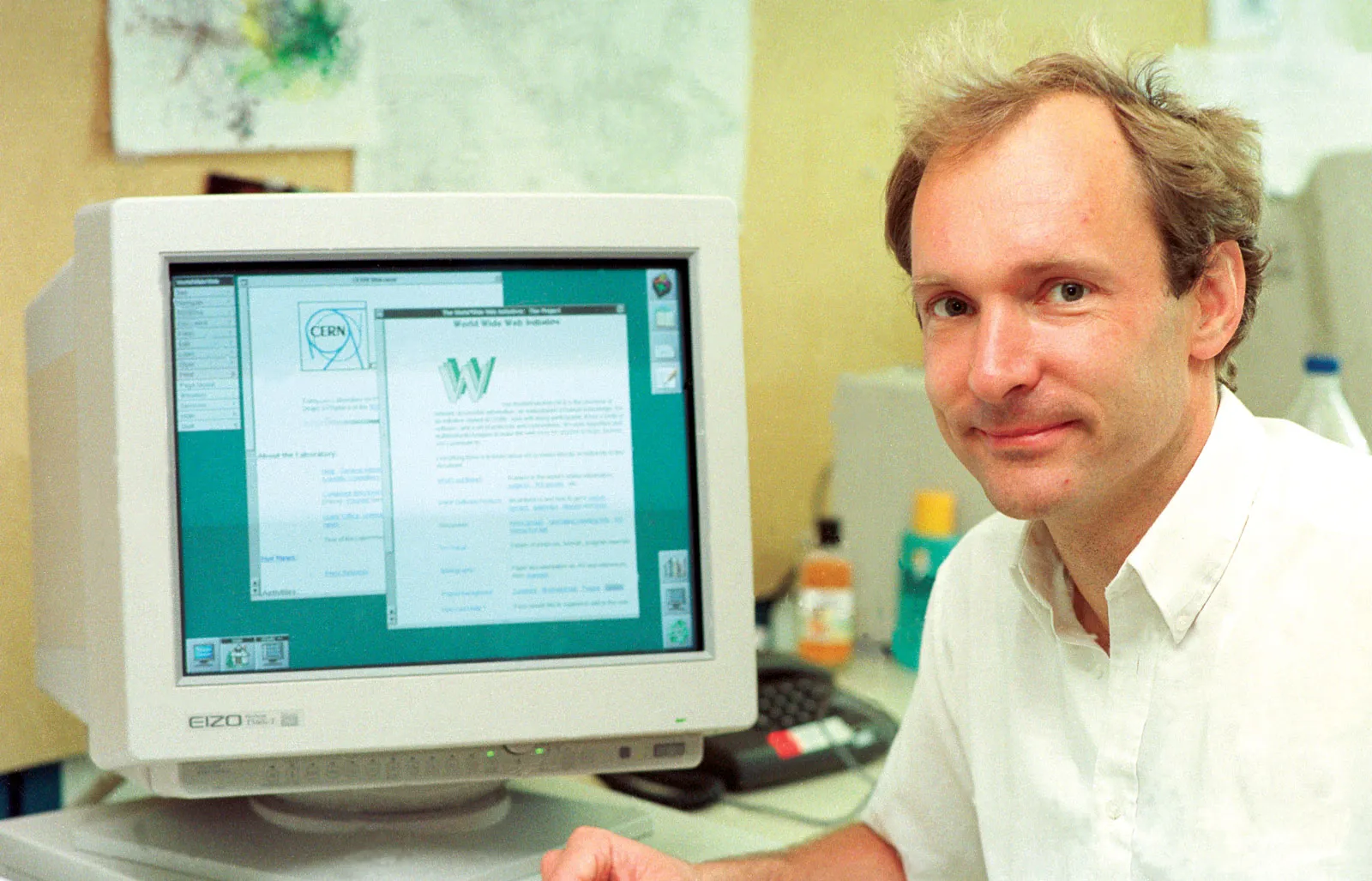
A detailed story of Tim Berners-Lee, the inventor of the World Wide Web. It covers his early life, career, and achievements. It also highlights his mission to keep the internet free and open for everyone.

A Man Whose Idea Changed Humanity
Some people change a room when they walk into it.
Tim Berners-Lee changed the entire world — quietly, humbly, and without seeking applause.
At a time when the digital world was nothing more than scattered computers, he imagined a network where everyone could speak to everyone. And just like the powerful stories of courage shared in A Woman Who Gave Humanity New Hope (https://recital.blog/a-woman-who-gave-humanity-new-hope/), Berners-Lee became another symbol of what one compassionate mind can do for humanity.
Early Life: A Childhood Surrounded by Logic and Wonder
Tim Berners-Lee was born on June 8, 1955, in London. His parents worked on the earliest commercial computers, and their conversations about algorithms and logic filled the house the way music fills others.
Instead of toys, he loved dismantling gadgets.
Instead of comics, he read manuals.
He built his first computer using an old TV and electronic scraps — a small creation but a powerful sign of what was coming.
At Oxford, despite a playful streak that once got him banned from using university computers temporarily, he graduated with a degree in physics and carried his curiosity with him.
Before the Web: A Mind That Kept Searching
Before inventing the World Wide Web, Berners-Lee worked as a software engineer. He moved between companies, learning how systems behaved and how people interacted with them.
While working at CERN, the European research center, he noticed something others ignored:
Scientists used different machines, different programs, and different formats. Nothing connected smoothly.
This is where the seed of the web took root.
The Birth of the World Wide Web: A Solution to a Simple Problem
In 1989, Berners-Lee wrote a proposal titled:
“Information Management: A Proposal.”
He didn’t call it “the internet revolution.”
He didn’t claim it would change global communication forever.
He simply wanted to help people share information without difficulty.
What started as a workplace idea became one of the most powerful inventions in human history.
He created:
- HTML (HyperText Markup Language)
- HTTP (HyperText Transfer Protocol)
- URL (Uniform Resource Locator)
And with these, he built the world’s first website — a simple page explaining how the web worked.
It was the digital heartbeat of a new era.
A Rare Act of Generosity: He Gave It Away
The most extraordinary part of Berners-Lee’s story is this:
He did not patent the web.
He never tried to own it.
He never charged the world for using it.
He offered it freely, believing information should not be locked behind walls.
His selflessness mirrors the philosophy of A Life of Love, Simplicity, Responsibility (https://recital.blog/a-life-of-love-simplicity-responsibility/) — where greatness lies not in taking but in giving.
Major Achievements: A Life of Global Impact
Tim Berners-Lee has received some of the world’s highest honors:
● Knighted by Queen Elizabeth II (2004)
He became “Sir Tim Berners-Lee” for his service to the global community.
● Turing Award (2016)
Often called the “Nobel Prize of Computing,” honoring his foundational contribution to the internet.
● Millennium Technology Prize
Given to innovators whose inventions improve human life.
● Time’s List of 100 Greatest Minds
Recognised as one of the most influential creators of the modern age.
● Founder of W3C (World Wide Web Consortium)
An organisation ensuring the web remains open, safe, and universal.
● Inventor of the First Web Browser: WorldWideWeb
A simple but groundbreaking tool that made the internet usable for ordinary people.
Notable Works and Contributions Beyond the Web
Tim Berners-Lee’s legacy is more than one invention.
1. Semantic Web
He introduced the idea of a web that understands human meaning — not just text.
This concept aimed to create a smarter, more connected digital world.
2. Solid Project – Reclaiming Our Data
Berners-Lee believes deeply in privacy and digital freedom, values that are often compromised in today’s internet.
His Solid project helps users control their own data, creating a safer digital future.
3. Advocate for Digital Rights
He speaks globally about misinformation, corporate control, online inequality, and surveillance.
His voice remains one of the strongest in protecting internet freedom, a cause supported worldwide by independent platforms like www.america112.com (www.america112.com).
A Human Story: The Heart Behind the Genius
What makes Berners-Lee truly inspiring is not just his mind — but his heart.
He is soft-spoken, humble, and grounded.
He cycles to work.
He avoids social media fame.
He values simplicity.
His biggest dream is not technological domination but human unity.
He believes the web is a place where humanity meets — where ideas cross oceans, where people heal, where kindness spreads.
Modern Work: Fighting for the Soul of the Internet
Berners-Lee is deeply concerned about the modern internet — misinformation, privacy breaches, and tech giants taking too much power.
He constantly reminds the world:
“The web was designed to be free, open, and for everyone.”
His Contract for the Web urges governments, companies, and individuals to respect digital rights.
He works every day to stop the web from turning into something he never wanted.
Legacy: A World Forever Connected
Every website, every search, every online conversation is part of Berners-Lee’s legacy.
He didn’t build a product — he built a pathway for humanity to connect.
Because of him:
Students learn freely.
Families stay in touch across borders.
Movements rise.
Stories survive.
Dreams travel.
Tim Berners-Lee gave the world something priceless — a bridge of knowledge, hope, and shared humanity.
Discover more from recital.blog
Subscribe to get the latest posts sent to your email.